Thursday, March 31, 2011

Visual Argument

           In my presentation titled “The Fall,” I make the claim that not all homeless people are crazy substance-abusers who don’t deserve our help and pity. Most of us have interacted with the homeless in some fashion and we often do our best to pass them by, whether it’s by stuffing our headphones into our ears or simply ignoring their calls. The homeless have commonly been characterized as substance-abusers or people too lazy to get on their feet, which leads us to view them oftentimes without pity and even disgust. My presentation aims to remind us that many of the homeless are just victims of circumstance and deserve as much compassion as any other person.
            My first image is of a group of young college graduates smiling triumphantly after what one would assume is their graduation ceremony. For many Americans, graduating from college is the first step towards becoming a true adult and finding a career that will sustain you for the rest of your life. As college students, most of us identify strongly with the goal of graduating and finding a job, thus eliciting some emotions of eagerness, hope, and happiness. The following image is of a young couple surveying the classic American home complete with green grass and a white fence. For many Americans, home ownership has been symbolic of the American Dream, the surest sign that one has made it in life. All of us identify strongly with our homes, something the homeless no longer have These two images together are designed to remind the viewer of the common goals they and the homeless all share in our pursuit of the American Dream, evoking a sense of fondness, content, pride, and optimism.
            The next series of images are more somber as they depict a kind of fall from grace. The third image is a black and white photo of a man clutching his head in seeming grief as the stock listings loom before him. This image is representative of the financial crisis that we are all familiar with and more specifically, the first step that led professionals like the ones depicted in the second image down the path to homelessness. The next image is a photo of a child crying as her parents argue in the background, an image that probably became more common as families across America began to feel the stress and pressure from the crisis. These two images inspire not only anger at the financial crisis but sadness and sympathy for those who suffered as a result of the financial collapse. The fifth image is of a young woman looking despondently at a past due bill notice. This is another image that likely became more common as people lost their jobs and livelihoods, thus preventing them from meeting their financial obligations. The sixth image is a cartoon of a man evicted from his home, another image all too common as part of the housing collapse. The fifth and sixth images both evoke sadness and pity in the viewer as they can sympathize with the trials that many Americans were forced to face as a result of the financial crisis. The seventh image shows a long line of people standing in front of a Californian Employment Development Department while the final image depicts a homeless man holding a cardboard sign stating "Will code HTML for food." In conjunction with the previous images, these two photos show that not only do the ranks of the homeless include those who held reputable jobs but that they are still human beings who continue to look for work but simply cannot find any. As a result, the viewer feels not only sadness and pity, but also shame as they realize some of their conceptions of the homeless may not be entirely true.
            Together these images are designed to make the viewer feel sadness and shame with the intent of making them rethink their views on who the homeless really are. The sadness felt by the audience at the plight of regular people who become homeless combined with the shame felt as the viewer realizes he or she has unfairly demonized human beings who may just have been victims of circumstance translates those emotions to a new belief: the homeless are not all crazy druggies and drunks who don’t deserve help and pity. With this in mind, I hope the viewer can look upon the homeless in a different and more sympathetic light.

Photo Credits:
First image: http://www.cs.wayne.edu/~suj/Retention/index.htm 4/4/11
Third image: http://www.world-crisis.net/ 3/30/11

Thursday, March 3, 2011

Written Pathetic Appeal

My written pathetic appeal addresses the growing focus on athletic programs at American universities.  I argue that this increased focus is financially detrimental to most universities and fails to aid in the academic mission of universities in others.  In order to convey my message, I cite the works of others and use indignant language to express my incredulity over what I perceive to be a ridiculous and infuriating situation.  I also try to employ enargeia with a hypothetical scenario.  I hope my readers feel anger and shame after reading my appeal, which will move them to push for a reform of the current athletic model, or at the very least rethink their stance on university athletics.  It's my wish that readers will interpret their anger and shame as results of the deplorable behavior of many athletic departments, moving them to protest against the system and call for change.

Appeal

A Hoot in the Dark: The Evolution of General Rhetoric

George Kennedy presents a series of  theses arguing that rhetoric is prior to things like speech and writing, using observations on animal communication to do so.  While I was intrigued by some of his propositions, I did find myself questioning some of his theories.  I was particularly skeptical of thesis VI ("Among the traditional parts of rhetoric (invention, arrangement, style, memory, and delivery), delivery is prior to the others") and thesis VIII ("Rhetorical invention, arrangement, style, memory, and delivery are phenomena of nature and prior to speech").

While I agreed with Kennedy's assessment that "Physical motion in response to some exigence occurs in the earliest and most primitive forms of life" (Kennedy 12), I was not convinced that that meant delivery comes before parts of rhetoric like invention.  I can certainly conceive of delivery coming before memory, style, and arrangement, but it seems highly unlikely to me for delivery to always come before invention.  Although Kennedy notes that he is referring to "action, not subtleties of vocalization" (Kennedy 12) when talking about delivery, I find that even this can't be held as a good rule.  I don't think everyone makes a discernible physical motion in response to someone's speech, unless the action of opening the mouth counts.

My criticism of thesis VIII is similar to that of thesis VI, namely that I can't see Kennedy's listed categories of rhetoric as always being prior to speech.  Perhaps I missed something in my reading, but does a baby's first words necessarily indicate that rhetorical invention took place before he/she said something?  I understand memory and delivery coming before that, but I can't get my head around rhetorical invention being prior to speech.

Damasio - Feelings vs Emotions

In chapter 7 of Descartes' Error, Damasio discusses the distinction between feelings and emotions.  Damasio further divides feelings into three varieties: feelings of basic universal emotions, feelings of subtle universal emotions, and background feelings.  The discussion of background feelings is particularly interesting to me; Damasio rather eloquently describes it as "not the Verdi of grand emotion, nor the Stravinsky of intellectualized emotion but rather a minimalist in tone and beat, the feeling of life itself, the sense of being" (Damasio 150).  Damasio argues that these background feelings, which corresponds to "the body state prevailing between emotions" (Damasio 150), are so important that without them "the very core of your representation of self would be broken" (Damasio 151).  Drawing from this view, Damasio proposes that the reason anosognosics have irrational responses and inappropriate emotions and feelings is due to a lack of ability to sense the current body state, which is is connected with background feeling.

What I began to think about was the connection between this background feeling and instincts, but of a slightly different kind than the animalistic instincts Damasio discusses earlier in the book.  Rather, I wonder how this applies to instincts in activities like sports or music, perhaps what Aristotle would have called knacks.  Is there a difference in a person having a good feel for a sport and performing the right move or play, and in the ability of a person to respond appropriately to a situation? Or to ask a different question, would a pro athlete be able to continue his/her high level of play after suffering an injury like Phineas Gage's?  I guess it would be unlikely, but how does this explain the gifts of so-called autistic savants?


Tuesday, February 15, 2011

Nussbaum - Emotion and Rationality

Martha Craven Nussbaum makes an interesting distinction between Aristotle and Socrates view of emotion when she states "Unlike the Socrates of the Republic, Aristotle does not believe that the good person, the person of practical wisdom, is 'sufficient unto himself' for eudaimonia, and therefore impervious to grief and fear" (Nussbaum 314).  As Nussbaum noted, Socrates berated his friends for their grief just prior to his death, as he believed it contrary to his "search for understanding without fear, resentment, or mourning" (Nussbaum 314).  Today, it seems that we've come to embrace Aristotle's view on the role of emotions.  That is, I feel that most people would agree with Aristotle's assessment that "it is right to grieve at the death of a friend, since that is an acknowledgment of the importance of the tie and the person" (Nussbaum 314).  Stoicism is now often seen as a sign of disinterest, a lack of passion, or plain rudeness depending on who you're talking to.  We expect people to be angry when a serious grievance is brought against them and to show grief when a loved one has passed on.  In this way, emotions become "recognitions of truth and value" (Nussbaum 316).

And yet I think there remains a popular domain in which Socrates' view that "there will be no room for the emotions of pity, fear, and grief" (Nussbaum 313): the male view of masculinity.  It seems that masculinity is often defined in ways that don't allow for men to show any so-called "soft" emotions.  Boys playing sports are told to "suck it up" or "walk it off" when feeling pain, even when that pain is terrible enough to bring tears.  Any sense of fear or grief is often met with any number of emasculating terms that I'm sure we're all familiar with.  The only socially acceptable emotions for people who subscribe to this viewpoint are emotions like anger.  Obviously, this isn't a hard and fast rule; there are plenty of cases where the "sensitive" male is appreciated and wanted, especially today.  However, it's a bit discomforting to know that the popular view of masculinity is still extremely prevalent in our society.  Nussbaum writes that "Rationality recognizes truth; the recognition of some ethical truths is impossible without emotion; indeed, certain emotions centrally involve such recognitions" (317); if this is this case, what happens to deliberation when we refuse to recognize these emotions?

Thursday, February 10, 2011

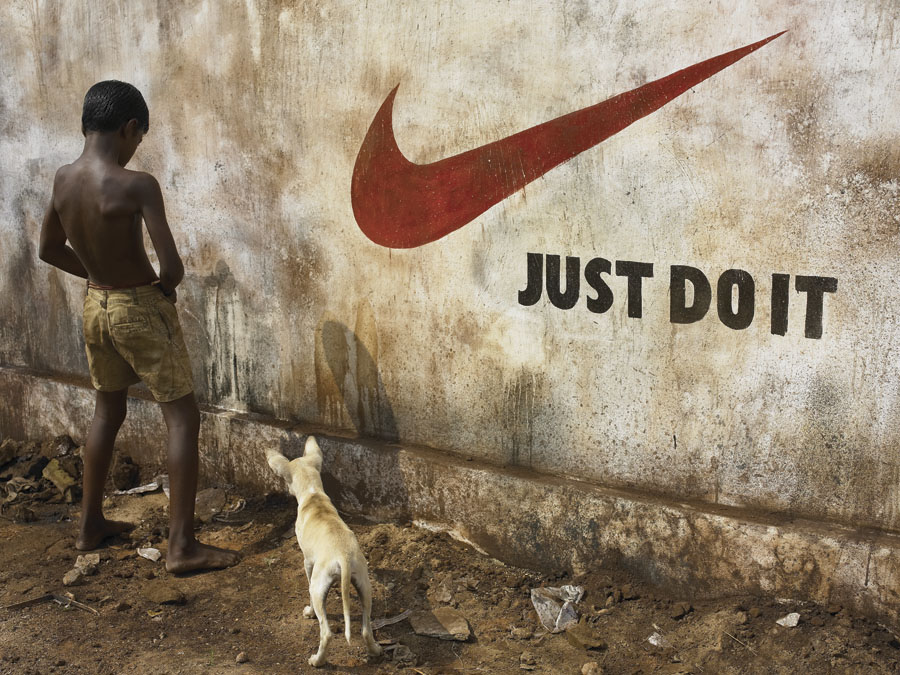
Visual Analysis: Brand Irony 1 - Just Do It


            The image above was photographed by Sharad Haksar, an award-winning advertising photographer and founder of advertising agency 1pointsize.  I originally found the image on the blog Fresh Pics (http://freshpics.blogspot.com/2008/09/brand-irony-by-sharad-haksar.html) but the image is also available as part of Haksar’s portfolio on his personal website.  The image, though it appears to be advertising Nike, is actually part of a series entitled “Brand Irony” which portrays ironic juxtapositions of famous brands around India.  Besides offering a humorous look at ironic product advertising, Haksar's "Brand Irony" series seems to also address issues of globalization and overaggressive advertising.  Although Haksar’s photo is not advertising the Nike brand per se, it appeals to the same audience of young and active people between the ages of 16 and 40.  More generally, Haksar’s photo addresses anybody on the Internet with an interest in photograph and advertising, especially given its ubiquity on other advertising and photography related sites. 
            The initial emotions this image evokes stem from joy and surprise.  The famous Nike Swoosh and its accompanying slogan “Just Do It” immediately inspires thrill and excitement in the viewer, due in large part because of Nike’s large media presence and association with athleticism.  The image of the boy urinating on the wall as a dog looks on is humorous, especially in contrast with the bold Nike logo and slogan, creating a surprising twist on the phrase “Just Do It.”  On closer inspection, however, the humor and thrill associated with the boy and Nike give way to feelings of anger and sadness.  The impoverished look of the barefoot boy along with his dirty surroundings leads the viewer to feel sad and even pity, pity for a child who looks like he cannot afford the shoes that Nike often advertises.  Even the dog next to the boy is a tiny and ragged creature, one that probably scavenges anything it finds to survive.  One would probably feel a little guilt and remorse for partaking in the commercial enterprises of Nike, and possibly even anger at Nike for advertising its products in an area where most people probably can’t afford to get the latest high-performance gear.  Nike's controversial history with sweatshops in countries like India is also brought up with the grimy conditions of the image.  The slogan “Just Do It” then becomes a motto that brings shame to the viewer and anger against Nike; for this boy and many others, life doesn’t offer the opportunity to “Just Do It”.
            With that in mind, the purpose of Haksar’s image changes drastically.  Rather than asking its viewer to buy Nike products, the photo asks the viewer to reconsider the heavy commercialism of corporations such as Nike and how they affect the communities in which they conduct business.  In another sense, Haksar’s photo also brings attention to the poverty of children in India and around the world, children who are unable to afford the types of products that Nike offers and yet are exposed to its tantalizing allure on the street.
            A complicated set of interpretations leads the viewer of Haksar’s photo to reconsider Nike’s aggressive advertising and business practices in countries like India.  If the viewer doesn’t move past the initial humor of the image, they may interpret the image as a clever example of advertising and consequently be compelled to purchase Nike in the future.  The true interpretation, however, arises from the feelings of shame and disgust that arise as one realizes that the boy in the image is not only unable to participate in the world that Nike advertises but is also completely disinterested.  The viewer experiences these feelings and translates it to a sense of resentment or just reconsideration of Nike, its business practices, and the lives of impoverished children.  Ultimately, Haksar’s image asks its viewer to consider the ethics of Nike’s advertising and the truth of its famous slogan.
            Haksar’s image doesn’t directly appeal to Aristotle’s stereotypical types.  Instead, Haksar’s photo depends on class classifications; that is, the photo relies on its viewer being part of the middle to upper-class of society, or some segment that can afford and purchases products produced by companies like Nike.  These are the people who probably view Nike’s creative advertisements and purchase Nike’s apparel without a second thought, which is the group that Sarkar is targeting.  On a very basic level, Sarkar assumes his audience believes in equity and humane treatment; otherwise, the image of a shirtless and shoeless boy peeing on a wall in a dirty street is an empty pathetic appeal.  In the end, Sarkar’s photo asks its viewer to consider one question: is life really so simple that you can say “Just Do It”?

Monday, February 7, 2011

Aristotle and the Young

In chapter 12 of Book 2, Aristotle describes the character of young people.  Among some of the things that Aristotle says about young men are that they "have strong passions, and tend to gratify them indiscriminately" and that "While they love honour, they love victory still more; for youth is eager for superiority over others, and victory is one form of this" (Aristotle 84).  Aristotle also writes that the young have "exalted notions, because they have not yet been humbled by life or learnt its necessary limitations; moreover, their hopeful disposition makes them think themselves equal to great things - and that means having exalted notions" and that "They would always rather do noble deeds than useful ones" (Aristotle 85).  In a very broad sense, I'd say that Aristotle is pretty accurate in his assessment of the character of youth.  After all, I think we've all had first-hand experience with the capriciousness of youth.

And yet I think the problems with Aristotle's fondness of categorizing things by opposites are also inherent in his description of youth.  Aristotle seemingly contradicts what he says about the young having exalted notions when he also writes "They are shy, accepting the rules of society in which they have been trained, and not yet believing in any other standard of honour" (Aristotle 84).  It seems to me that young people cannot be both accepting of the rules of society and be ignorant of life's "necessary limitations".  Furthermore, I feel like today's youth exhibit many of the characteristics Aristotle attributes to old people such as distrust and cynicism.  Maybe it's because of how accessible information is and the faster pace of life today, but I get the feeling that young people today are perhaps a little more jaded than how Aristotle described them.  Which isn't to say that Aristotle's guidelines shouldn't be used; rather, his descriptions in certain aspects need revision to be more applicable to today's audience.